Malawi’s improving foreign exchange position is yet to translate into consistent forex supply through authorised dealer banks (ADBs), with latest Reserve Bank of Malawi (RBM) data showing a sharp fall in foreign currency purchased from customers.
The central bank’s Financial Market Developments Report shows that ADBs purchased $45.60 million from customers in August, down 48.5 percent from $88.58 million in June and $77.36 million in July.
Meanwhile, banks sold $62.40 million to customers in August, exceeding purchases by $16.8 million. In July, sales of $81.13 million had similarly surpassed purchases of $77.36 million.
The figures raise questions about how improvements in the country’s headline foreign exchange position are filtering through to businesses and other users dependent on the formal market.
Scotland-based Malawian economist Velli Nyirongo said the figures suggest the forex position remains fragile rather than fully normalised.
“The key issue is whether foreign exchange is becoming consistently available through normal market channels, rather than depending on periodic official intervention,” he said.
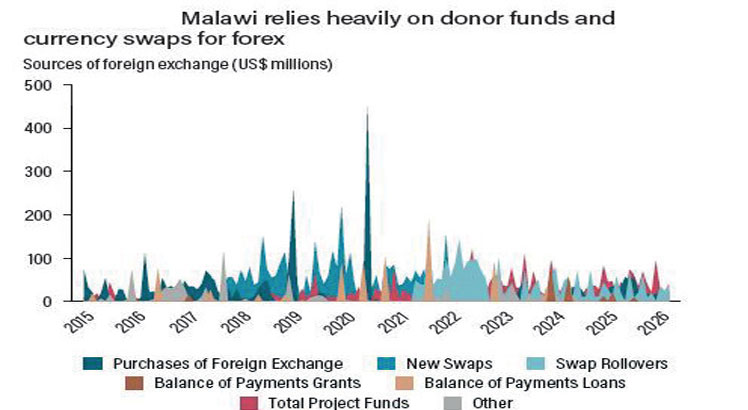
Nyirongo said improvements in official reserves do not necessarily immediately translate into greater forex availability because reserves represent a stock of foreign currency while businesses depend on flows through commercial banks.
He said reserves could improve through external financing, donor inflows, government borrowing or other one-off receipts without a corresponding sustained increase in export earnings and private-sector forex supply.
In a seperate interview, Mzuzu University economics lecturer Christopher Mbukwa said the decline in ADB purchases could also reflect incentives for forex holders to sell outside the formal banking system, where parallel market exchange rates may be more attractive.
He said a sustainable improvement should instead be reflected in rising ADB purchases, reduced RBM forex sales, stronger net reserves, longer import cover and a narrowing gap between official and parallel-market exchange rates.
Banks purchased $12.03 million during the week ending September 25 against sales of $16.12 million, producing a $4.09 million shortfall. But purchases exceeded sales by $3.86 million the preceding week.
The volatility continued into daily trading. On September 28, ADBs bought $1.60 million and sold $4.97 million, but by October 1, purchases had jumped to $6.21 million against sales of $1.02 million.
Nyirongo said stronger evidence of recovery would include fewer unmet forex orders, shorter import-payment delays, stronger export receipts and a narrowing official-parallel exchange-rate gap.
Mbukwa concurred, saying the clearest test is whether businesses and individuals can obtain foreign currency when they need it.
The RBM figures do not indicate the factors behind the decline in ADB purchases or indicate whether the central bank supplied forex to cover the gap between bank purchases and sales.